PBM Strategy for Mid-Sized Employers: Five Capabilities to Look For
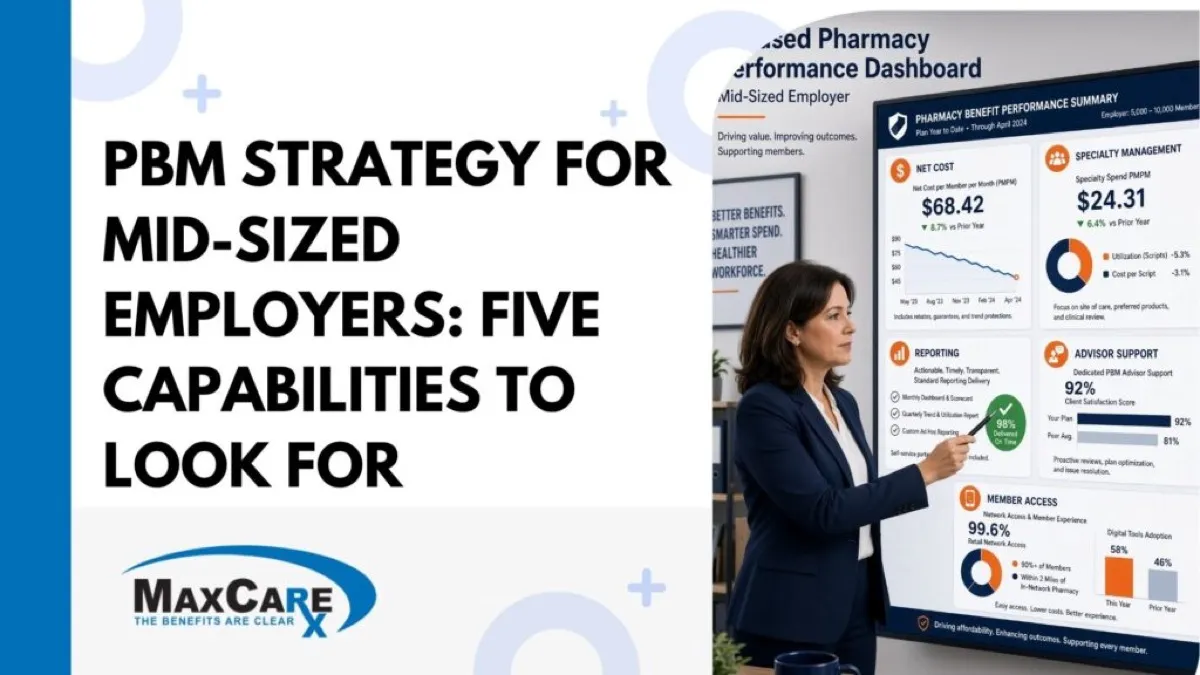
A mid-sized employer does not need an enterprise-sized benefits department to manage pharmacy spend with discipline. It does need a pharmacy benefit manager (PBM) that makes cost drivers visible, manages high-impact utilization proactively, explains performance clearly, and supports decisions across HR, finance, benefits advisors, and plan partners.
For these organizations, the strongest PBM is not necessarily the one that presents the largest rebate guarantee or the broadest discount. It is the one that helps the employer understand the true lowest net cost, anticipate financial risk, protect appropriate member access, and act on the information it receives.
This guide explains the five capabilities mid-sized employers should evaluate, the pharmacy benefit metrics they should monitor, and the questions that can turn a PBM proposal into a defensible business decision.
Key Takeaways
- Mid-sized employers need visibility into total pharmacy cost, not only discounts, administrative fees, or rebate guarantees.
- Specialty and other high-cost claims require proactive clinical oversight because a small number of claims can materially affect overall plan performance.
- Reporting should tell a lean benefits team what happened, why it happened, and which action deserves attention.
- PBM service, implementation support, and member access should be evaluated alongside contract pricing.
- A credible comparison uses the employer’s claims data, a common net-cost methodology, disclosed assumptions, and measurable performance standards.
What Is Pharmacy Benefit Management for a Mid-Sized Employer?
Pharmacy benefit management for a mid-sized employer is the coordinated financial, clinical, network, and member-service work required to manage prescription drug coverage. The model should give a lean internal team enough visibility and support to control total cost, respond to high-impact utilization, and maintain appropriate access without needing an internal pharmacy analytics department.
There is no single, universally accepted employee or covered-life threshold for the term “mid-sized.” The more useful distinction is operational: the employer has meaningful pharmacy exposure, but HR and finance leaders may manage the benefit alongside many other responsibilities. That makes clarity and responsiveness especially important.
Why Can Pharmacy Spend Be More Volatile at Mid-Market Scale?
Pharmacy cost is not distributed evenly across every member or every month. A small number of specialty or other high-cost therapies can represent a significant share of an employer’s annual spending. New utilization, a change in therapy, or an unexpected claimant can therefore alter per-member results quickly.
The broader specialty market reinforces that concern. The Federal Trade Commission (FTC) reported that U.S. specialty drug spending increased from $113 billion in 2016 to $237 billion in 2023. That is national market context, not a prediction for an individual employer, but it illustrates why specialty oversight and forecasting deserve sustained attention. Read the FTC specialty-drug report.
Mid-sized employers may also have limited time to interpret claims files, reconcile rebates, investigate trend changes, or coordinate several pharmacy vendors. A PBM should reduce that management burden by turning complex data into clear priorities and accountable next steps.
Five PBM Capabilities Mid-Sized Employers Need
1. Transparent net-cost economics
The employer should be able to identify what it pays for medications, what the PBM pays pharmacies, which fees apply, how rebates and other price concessions are handled, and how those amounts reconcile over time. Pricing definitions should be consistent across the proposal, contract, invoices, and reporting.
A high rebate guarantee can look attractive while obscuring higher drug costs, retained revenue, or utilization that increases overall spending. The better question is whether the complete arrangement produces the lowest appropriate net cost after all material financial components are considered.
- Ask for: Clear definitions of pass-through pricing, spread, rebates, fees, guarantees, exclusions, reconciliation, and audit rights.
2. Proactive specialty and utilization management
Transparent pricing does not manage utilization by itself. Employers should understand how the PBM evaluates prior authorization, formulary options, specialty therapies, appropriate generic or biosimilar alternatives, clinical exceptions, and emerging cost categories.
The purpose should be clinically responsible cost control, not restriction for its own sake. Every program should have a defined objective, a member-safeguard process, and reporting that connects clinical activity to financial and access outcomes.
- Ask for: Clinical governance, program criteria, exception procedures, reporting measures, and examples of how recommendations reach the employer and its advisors.
3. Actionable reporting for a lean benefits team
A report should do more than list transactions. It should explain which cost drivers changed, what caused the change, whether the result was expected, and what the employer should consider next. HR leaders and CFOs need an executive view, while brokers, consultants, and third party administrators (TPAs) may need detailed claims-level support.
The Centers for Medicare and Medicaid Services (CMS) prescription-drug reporting requirements illustrate the categories that matter at a market level: prescription spending, the drugs accounting for the most spending, frequently prescribed drugs, manufacturer rebates, and member cost sharing. Employer reporting should translate comparable areas into plan-specific decisions.
Review the CMS Prescription Drug Data Collection resource.
- Ask for: Sample executive and detailed reports, data definitions, delivery schedules, trend explanations, and a named process for following up on recommendations.
4. Responsive advisory and implementation support
Mid-sized employers often rely on a broker, consultant, or TPA to coordinate pharmacy strategy. The PBM should make that partnership easier by defining who owns implementation, clinical questions, reporting, member issues, contract administration, and performance reviews.
Before selecting a partner, employers should understand the service model after the sale. A strong proposal identifies the people, meeting cadence, escalation path, implementation responsibilities, and decisions that require employer approval.
- Ask for: An implementation plan, service-team structure, response standards, governance calendar, escalation process, and references from comparable clients.
5. Member access and network stability
Cost management should not be separated from the member experience. Review the retail network, specialty access, mail options, geographic coverage, disruption analysis, exception process, and communication plan. Employers with workers in smaller cities or rural communities should examine whether members can continue using accessible community pharmacies.
The right network is not simply the largest one. It is the network that supports reasonable cost, appropriate access, continuity, and a manageable transition for the employer’s actual workforce.
- Ask for: A claims-based network disruption analysis and a documented plan for members affected by pharmacy, formulary, or clinical-program changes.
Which Pharmacy Benefit Metrics Should Employers Monitor?
A useful dashboard should be small enough to review regularly and detailed enough to prompt action. The following measures provide a practical starting point.
| Metric | What It Shows | Management Question |
| Total plan-paid cost and PMPM | Overall pharmacy expense and trend after adjusting for enrollment. | Is cost changing because of price, utilization, mix, or membership? |
| Specialty spend and utilization | The financial concentration and use of high-cost therapies. | Which claims need clinical review, forecasting, or a different strategy? |
| High-cost claimant concentration | How much total spend is driven by a small number of members or therapies. | Are the largest claims clinically appropriate and actively managed? |
| Generic and biosimilar utilization | Use of lower-cost options where clinically appropriate. | Are formulary and clinical programs finding reasonable alternatives? |
| Rebates and price concessions | Amounts earned, passed through, and reconciled under the contract. | Do reported amounts match the definitions and timing in the agreement? |
| Clinical program activity | Authorizations, interventions, exceptions, and measurable program results. | Are programs improving cost and access rather than simply adding process? |
| Network and member access | Pharmacy use, disruption, exceptions, and geographic coverage. | Are cost strategies creating avoidable access or service problems? |
Reporting categories should be tailored to the employer’s contract, population, plan design, and available data. Metrics are management tools, not standalone proof of performance.
How Should a Mid-Sized Employer Compare PBM Proposals?
A fair comparison requires a common set of inputs. Each bidder should use the same claims period, eligibility assumptions, benefit design, pharmacy network assumptions, and definitions of net cost. Guaranteed amounts should be separated from modeled opportunities, and the employer should understand what happens if actual performance differs from the projection.
- Use the same claims and eligibility data for each bidder.
- Define total net cost before reviewing projected savings.
- Identify every material source of PBM and affiliate compensation.
- Separate contract guarantees from clinical or utilization estimates.
- Evaluate reporting, service, implementation, and access alongside price.
- Document assumptions, exclusions, and the process for reconciling results.
This structure helps HR and finance leaders make a decision they can explain. It also gives brokers, consultants, and TPAs a consistent framework for testing competing proposals.
When Should an Employer Evaluate Its Current PBM?
An evaluation may be appropriate when pharmacy cost changes cannot be explained, rebates cannot be reconciled, reporting does not lead to action, specialty claims receive limited oversight, service issues persist, or contract renewal is approaching without a clear performance baseline.
An evaluation does not require a predetermined decision to switch. Its purpose is to determine whether the current model remains competitive, transparent, clinically responsible, and operationally workable. If the evidence does not justify a change, the review should still identify improvements the employer can pursue with its existing partner.
How MaxCare Rx Supports Mid-Sized Employers
MaxCare Rx is an independent, employer-aligned pharmacy benefit manager focused on reducing total pharmacy spend while preserving appropriate member access and improving plan performance. Its model combines 100% pass-through pricing, zero spread pricing, clinically driven cost management, transparent reporting, and high-touch advisory support.
For a mid-sized employer, that combination is designed to make pharmacy strategy more manageable. MaxCare helps employers and their advisors identify cost drivers, understand the financial impact of clinical decisions, monitor performance, and focus internal attention where it can make the greatest difference.
A pharmacy spend analysis can establish the current-state baseline, identify material opportunities, and determine whether a different strategy is financially and operationally justified. The analysis should be grounded in the employer’s own claims and contract terms, with assumptions stated clearly.
Next step: Request a pharmacy spend analysis from MaxCare Rx.
Frequently Asked Questions
What should a mid-sized employer look for in a PBM?
Look for transparent net-cost economics, clinically responsible utilization management, actionable reporting, responsive support, and a network strategy that protects appropriate member access. Evaluate the complete operating model, not one headline guarantee.
How can a small benefits team manage pharmacy spend?
Use a focused dashboard, establish a regular performance-review cadence, require the PBM to explain major cost drivers, and assign clear ownership across the employer, PBM, broker, consultant, and TPA.
Which pharmacy benefit metrics matter most?
Start with total plan-paid cost and PMPM, specialty spend, high-cost claimant concentration, generic and biosimilar utilization, rebates, clinical-program activity, and member-access measures. Add metrics only when they support a decision.
How do specialty drugs affect mid-sized employers?
Specialty therapies can create significant financial concentration because a small number of claims may represent a meaningful share of total spending. Employers need forecasting, clinical oversight, appropriate alternatives, and clear reporting.
Is pass-through pricing always less expensive?
Not automatically. Pass-through pricing improves visibility into drug costs and financial flows, but total performance also depends on utilization, specialty management, formulary strategy, fees, network economics, and plan design.
How should employers compare PBM proposals?
Use common claims data, benefit assumptions, network assumptions, and a defined net-cost methodology. Separate guarantees from estimates and evaluate service, reporting, clinical programs, implementation, and member access alongside financial projections.
What data is needed for a pharmacy spend analysis?
A typical review uses prescription claims, eligibility information, plan design, contract terms, rebate information, and available utilization or clinical reports. Data should be transferred through a secure, approved process.
Conclusion: Mid-Sized Does Not Have to Mean Under-Managed
Mid-sized employers may have lean benefits teams, but their pharmacy strategy still deserves enterprise-level financial discipline. The right PBM should make total cost understandable, manage high-impact utilization proactively, provide guidance that leads to action, and support members throughout the benefit experience.
By evaluating these five capabilities and monitoring a focused set of performance measures, employers can make pharmacy benefit decisions with greater clarity and control. That is the practical, employer-aligned approach MaxCare Rx brings to mid-sized organizations and their advisors.